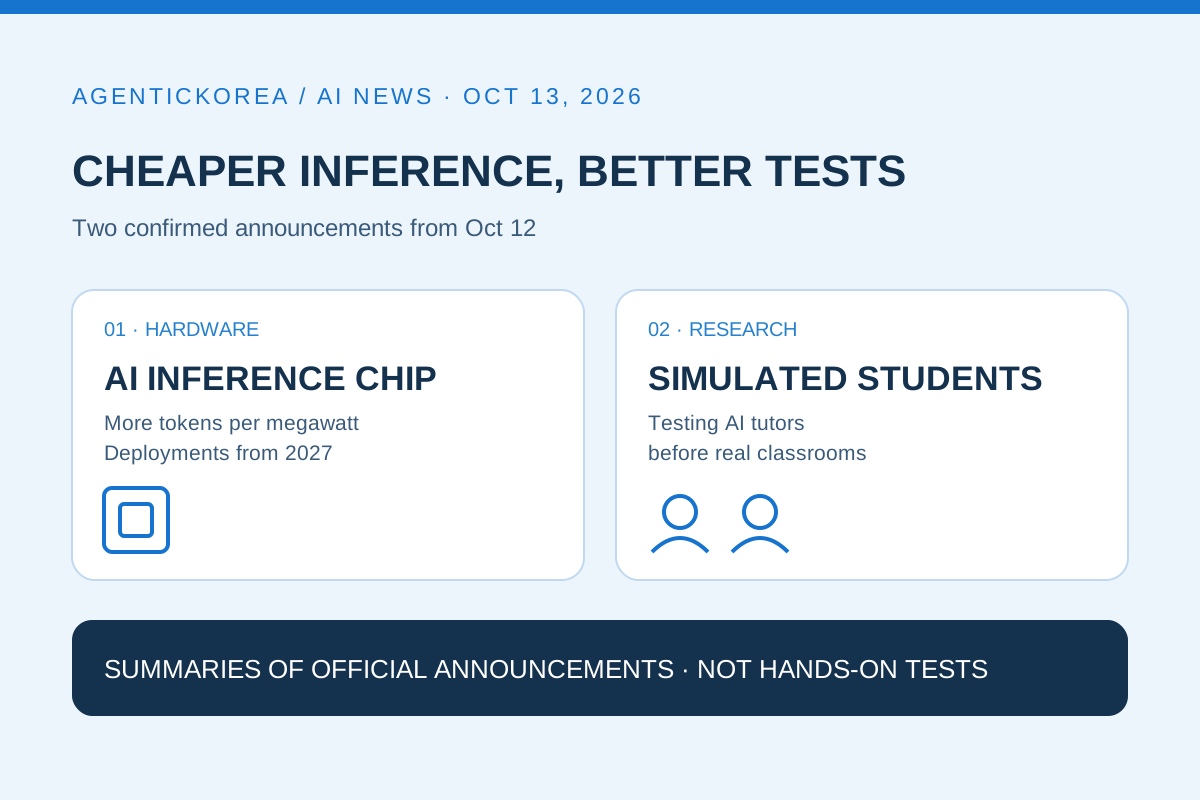
Two AI announcements first published Oct 11 to 13, confirmed from official sources: Microsoft's third-generation Maia 300 chip aimed at inference costs, and Microsoft Research's work on testing AI tutors with simulated students.
This roundup covers AI news first published after 7:30 a.m. Korea time on Oct 11, 2026, limited to items whose date and content I confirmed on official company blogs, compiled on Oct 13, 2026. It summarizes the announcements; it is not based on hands-on use or testing. No major model launch could be confirmed from official sources in this window, so only the two confirmed items are covered.
Microsoft unveils Maia 300, its third-generation AI chip (Oct 12)
What happened: On Oct 12 (US time), Microsoft announced Maia 300, the third generation of its in-house AI chip. The company says it is designed for inference, the work of generating AI answers, especially long-context and memory-heavy workloads. According to Microsoft, Maia 300 delivers 40% more tokens per megawatt than leading GPU-based systems, and a rack of 96 accelerators delivers up to 7x the token throughput of the previous-generation Maia 200. Production deployments begin in 2027, and Microsoft says it will scale the Maia family to multi-gigawatt deployments starting in 2027, making it its primary inference system.
• The previous generation in use today: Maia 200 is running in the US, Europe, and Australia and serves Microsoft Copilot, with GitHub Copilot and Microsoft Foundry to follow by the end of the year.
• Planned uses for Maia 300: GitHub coding experiences, Foundry model serving, and inference for Microsoft's own MAI models, among others.
• About the figures: the 40% and 7x numbers are Microsoft's own comparisons, not results verified by an outside party.
What it means for users: You will never pick a chip yourself, but the price and speed of AI services ultimately come from inference costs like these. If large companies keep lowering those costs with their own chips, services may shift toward handling longer documents or allowing more use for the same price. Actual price changes, though, should be confirmed when each service updates its official pricing.
Source: Microsoft official blog (Scott Guthrie, Oct 12)
Microsoft Research releases "simulated students" for testing AI tutors (Oct 12)
What happened: On Oct 12, Microsoft Research released StudentSim, a system that simulates how an individual student answers questions, along with an evaluation method called StudentSimEval. The work starts from a practical problem: testing whether AI tutors really help with human studies is slow and expensive, while a general language model told to play a student may sound like one but reason far above that student's level, making a tutor look better than it is.
• What it measures: how closely the simulator reproduces a specific student's real answers, and whether it changes its answer after reading the tutor's guidance. It was tested in three areas: chess, second-language English writing, and math.
• Chess experiment: a chess tutor trained using StudentSim as its reward signal reached 90.5% accuracy, compared with 75.7% without the extra training. The researchers describe this as a proof of concept.
• Limits: the team says it is a research system, not a product, is not deployed in classrooms, and is not meant to replace teachers. It also notes simulators cannot replace studies with real learners. The paper and code are public.
What it means for users: For anyone using AI to study or to create teaching materials, this is a reminder that "the AI tutor looks good" and "the student actually learned" can be different things. When choosing an AI learning tool, check separately whether a learner at your level actually understood, rather than judging by how convincing the explanations sound.
Source: Microsoft Research official blog (Oct 12)
Trends from today's news
Both items are less about making AI bigger and more about how cheaply and accurately AI can be used. One is hardware that lowers inference costs; the other is an evaluation method that properly measures whether AI tutors work. The same questions matter when you use AI for real work and study. For how to check results, see the result-checking steps in How to write good AI prompts, and for earlier news, see AI news at a glance (Oct 7 to 9).
Sources
Microsoft — Microsoft to expand Maia chip for the AI era (Oct 12, 2026) ↗
Microsoft Research — Simulating student learning for better AI tutoring (Oct 12, 2026) ↗