Analyze CXMT’s planned 4F² server DRAM through the lens of AI infrastructure: distinguish it from G5 production, understand HBM and DDR5, and assess conditional implications for Samsung and SK hynix using five verification questions.
The debate around ChangXin Memory Technologies (CXMT) and its planned next-generation DRAM deserves attention from the AI industry. As AI services grow, the memory that holds and moves data matters alongside the chips that perform computation. Announcing a new architecture, however, is insufficient evidence that established suppliers have lost their technological advantage.
This analysis focuses on the recent 4F² server DRAM preview. It distinguishes reporting checked on Oct 13, 2026 from official materials published by manufacturers and NVIDIA. A company's reported plans differ from validated commercial products. The industry implications below are Agentickorea's conditional interpretation.
The CXMT debate: what was announced and what remains unverified
According to Seoul Economic Daily's Oct 12 report, CXMT said at an integrated chip and chiplet conference in Shanghai on Oct 9–10 that it planned to introduce a next-generation DDR5 RDIMM using a 4F² architecture by year-end. The report also says detailed specifications and the prospects for large-scale production remain difficult to assess. This article treats the news as a product preview, not completed volume production.
A separate announcement should be kept distinct. CXMT's official Sep 20 release concerns volume production of its G5 technology platform and LPDDR5X products using that platform. That announcement does not itself establish large-scale supply of the newly previewed 4F² DDR5 RDIMM.
CXMT's official November 2025 release already described demonstrations of DDR5 and several module types, including RDIMMs. The new issue is therefore the plan for a subsequent product using a different cell architecture, rather than the first mention of server memory. Mixing dates, product categories and development stages distorts the pace of the company's progress.
4F² describes cell area before it says anything about AI speed
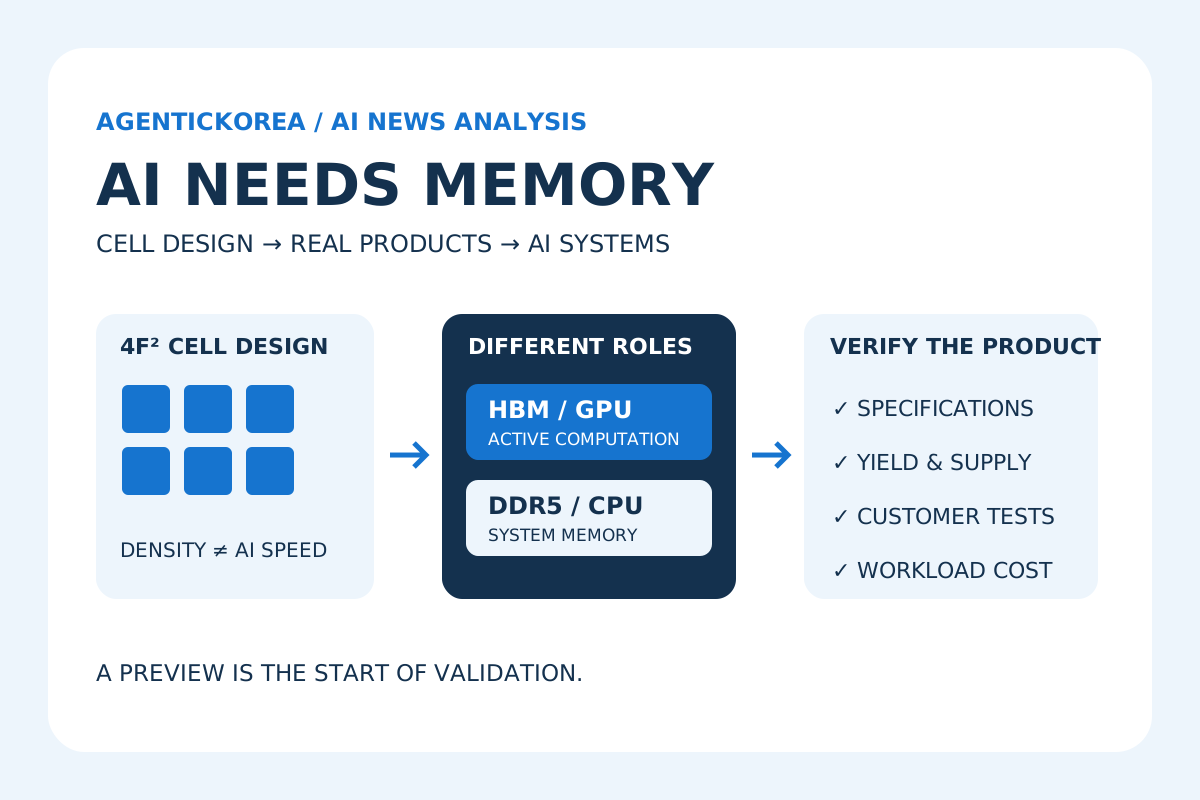
SK hynix's official June 2025 roadmap explains 4F² as a high-density technology in which each storage cell occupies an area of 2F by 2F. F denotes the minimum feature size. The number describes memory cell area; it is neither an AI benchmark score nor a product generation name.
Assuming the same F, moving from 6F² to 4F² reduces cell area by about 33% and increases theoretical cell-array density to 1.5 times its previous value. This is simple area arithmetic. A complete chip includes peripheral circuits, and real process conditions differ. It does not follow that finished-product capacity, cost or speed improves by the same proportion.
SK hynix also disclosed vertical-gate, 4F² and 3D DRAM directions in that roadmap. Comparing one company's scheduled product unveiling with another company's production target cannot establish an overall technology ranking. Actual products need comparison under equivalent capacity, performance, power and reliability requirements.
AI servers need both HBM and DDR5
A particularly misleading shortcut is to interpret progress in server DDR5 as proof of HBM competitiveness. Both use DRAM, but they occupy different positions in a system and use different connections.
Micron's official materials describe HBM for GPU-attached memory alongside DDR5 RDIMMs for CPU-attached memory in AI servers. HBM supports rapid data movement for accelerators, while DDR5 RDIMMs serve as main memory for data processed by the CPU. DDR5 is consequently an important AI infrastructure component too.
Yet a DDR5 module preview does not demonstrate the performance or customer adoption of HBM beside a GPU. After identifying a product as “memory used in AI,” readers should ask precisely which component's competitive position is changing.
Long conversations and agents make memory more important
During generation, an LLM can store and reuse parts of its earlier token computations in a KV cache. NVIDIA's technical documentation explains that this reduces repeated computation at the expense of memory capacity and bandwidth. Bandwidth means how much data can move in a given period.
Another official NVIDIA explanation describes placing inference context across GPU HBM, system RAM, SSDs and other tiers. This can extend capacity, but movement between tiers introduces latency and cost considerations. A larger cache alone does not solve every performance problem.
This is where the CXMT news connects with AI. Agentickorea's interpretation is that more reliable, cost-efficient server memory supply could broaden infrastructure options for long-context workloads. Conversely, a new DRAM architecture may produce limited service improvements when data movement and system configuration remain bottlenecks. KV cache is a computation-reuse mechanism; it does not imply that AI permanently remembers information about a user.
Read the implications for Samsung and SK hynix conditionally
The preview matters because it could change future supply competition. That possibility should not be presented as an established earnings result or price change. The following scenarios are analysis based on the technical architecture and available public information.
• If production and customer validation succeed: buyers in the relevant server DRAM market could gain more options, putting pressure on incumbents' product and pricing strategies. The scale of the effect depends on actual supply and adoption.
• If reliability or cost targets take longer: a product unveiling might have limited or delayed market impact. Readers need evidence about yield, the share of manufactured chips that function correctly, and saleable volume.
• Even if competition increases in server DDR5: that outcome cannot determine the winner across the entire HBM market. Supply, performance and system validation need examination separately for each product.
“Safe” and “already overtaken” are both inadequate assessments of Korean suppliers. Long-term competitiveness depends on developing new architectures and consistently delivering products customers can use reliably.
Five things to check in the next report
After reading a headline, these questions help assess the distance between an announcement and a business outcome. Leave undisclosed information unknown.
• Product specifications: are capacity, speed, power and error-handling requirements available?
• Development stage: is this research, a prototype, a customer sample or a product for sale?
• Production reality: is there verifiable evidence of yield, shipments and sustained supply?
• Customer validation: which server platforms have been checked, and how extensive are compatibility and stability tests?
• AI impact: beyond cell-area improvement, how do actual workload latency, throughput and total cost change?
The educational lesson is that AI cannot be understood through software alone. Models, memory, data movement and validation must work together to make a service. Take the announcement seriously while resisting conclusions about unverified production and performance.
To connect computer memory with running AI, read What is a local LLM?. For the architecture behind answering questions using retrieved documents, see RAG explained. Start with the learning guide to study the concepts in sequence.
Sources
서울경제 — CXMT의 4F² 서버 D램 출시 예고 보도 (2026-10-12, 회사 계획의 보도 출처) ↗
CXMT 공식 — G5 플랫폼·LPDDR5X 양산 발표 (2026-09-20) ↗
CXMT 공식 — DDR5·LPDDR5X와 RDIMM 등 모듈 전시 (2025-11-23) ↗
SK hynix 공식 — 4F²·수직 게이트·3D D램 로드맵 (2025-06-10) ↗
Micron 공식 — AI 서버의 GPU HBM·CPU DDR5 RDIMM (2024-05-01) ↗