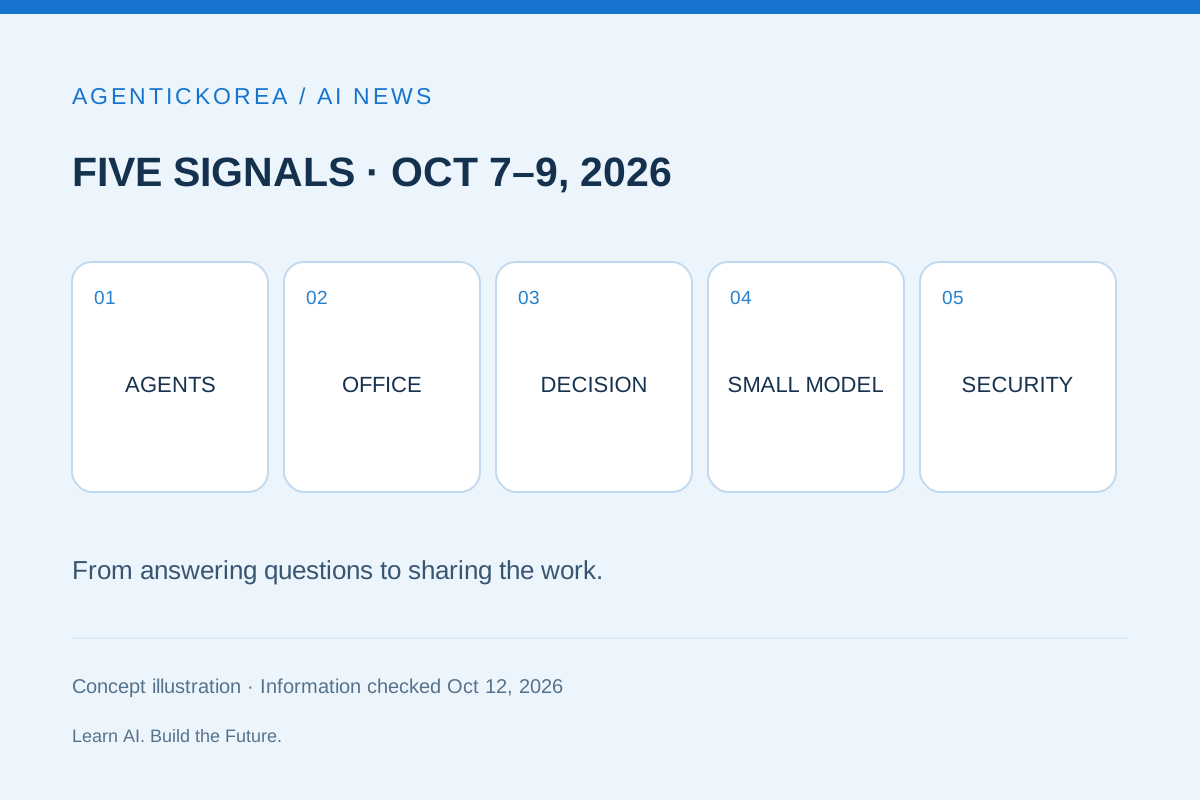
Five AI announcements from Google, Microsoft and Anthropic on Oct 7–9, each as a short headline and summary, plus what they show about where AI is heading: agents, small models, decision models and AI security.
These announcements were made on Oct 7–9, 2026, and the information was checked on Oct 12, 2026. Each item is a short summary of the official announcement, not a hands-on review or performance test. Availability can differ by account and region, so check each service directly.
Google announces Gemini agent for delegated work (Oct 8)
At Gemini at Work 2026, Google Cloud introduced Gemini agent for the workplace. It connects answering questions, creating content and running code in one workspace, and is designed to take a goal and use tools and business systems to carry the work forward. Model choice, cost controls and enterprise management features were announced alongside it.
Why it matters: AI is moving from something you ask questions to something you hand work to.
Microsoft brings Word, Excel and PowerPoint into the Copilot app (Oct 9)
The new Copilot app lets users create, edit and collaborate on Word, Excel and PowerPoint files. Work started in Chat or Cowork can continue as an editable file, saved to OneDrive. At announcement, the rollout starts with Frontier customers.
Why it matters: the line between the chat window and the document editor is fading, and refining AI drafts together becomes the main workflow.
Microsoft-Decision-1: a model built to choose and classify (Oct 9)
Microsoft released Microsoft-Decision-1 as a public preview in Foundry. It is designed for decisions among predefined options, such as classification, routing and evaluation. It is based on Qwen3.5-9B, and the documented input price is $0.042 per million tokens, with output tokens free.
Why it matters: system designs are starting to split roles, with one AI that writes and another that decides.
Anthropic launches Claude Haiku 5.5 for repetitive, high-volume work (Oct 7)
Anthropic launched Claude Haiku 5.5, a small and fast model (API model ID claude-haiku-5-5). Per million tokens, prompts up to 100,000 tokens cost $0.10 input and $0.50 output; above that threshold, $0.50 input and $2.50 output.
Why it matters: rather than sending every task to the largest model, simple repetitive work is increasingly routed to cheaper small models.
Anthropic Cyber Mission offers free open-source security scans (Oct 8)
Anthropic announced Cyber Mission to support infrastructure and open-source defense, and introduced OSS Scanner, which provides regular free security scans to participating open-source projects. The reports are model-generated, delivered without human review, and explicitly noted as possibly containing errors.
Why it matters: AI is increasingly used on the defensive side of security, but verifying and fixing what it finds is still a human job.
What these five announcements say about where AI is heading
• Agents: AI is moving beyond answers toward using tools and finishing tasks (Gemini agent).
• Built into work tools: AI is moving inside documents, spreadsheets and slides instead of a separate window (Office in Copilot).
• Division of roles: instead of one large model, small and decision models are assigned to specific tasks (Haiku 5.5, Decision-1).
• Price competition: token prices for small and decision models keep falling.
• Safety and verification: the higher the stakes, as in security, the more human review of AI output is emphasized (Cyber Mission).
The common thread is that the key question is shifting from "what can AI do?" to "which work should go to which AI, and how far?" For the basics of agents and model structure, see the learning guide. For how the tools differ, read ChatGPT, Codex and Claude compared, and for matching models to tasks, see choosing a Claude model.
Sources
Google — Gemini agent announcement (Oct 8, 2026) ↗
Google Cloud — Gemini at Work 2026 (Oct 8, 2026) ↗
Microsoft — Office in the new Copilot app (Oct 9, 2026) ↗
Microsoft Foundry — Decision-1 public preview (Oct 9, 2026) ↗
Microsoft Command Line — Decision-1 technical explanation (Oct 9, 2026) ↗