As AI replaces more and more digital work, this everyday essay looks for a competitive edge in content with a human touch, the appeal of imperfection, and the otaku-like habit of loving one thing deeply where it meets the offline world.
Following AI news these days, I keep marveling at how fast everything is turning digital. Writing, images, music and now even physical work are being handled by AI and robots. Strangely, the more of this news I see, the more curious I become about the opposite side. I wonder whether, now that the age of AI has arrived, the real competitive edge might actually be analog. This is not a post with answers. It is an everyday note about what has been on my mind while studying AI.
The more everything goes digital, the rarer the human touch becomes
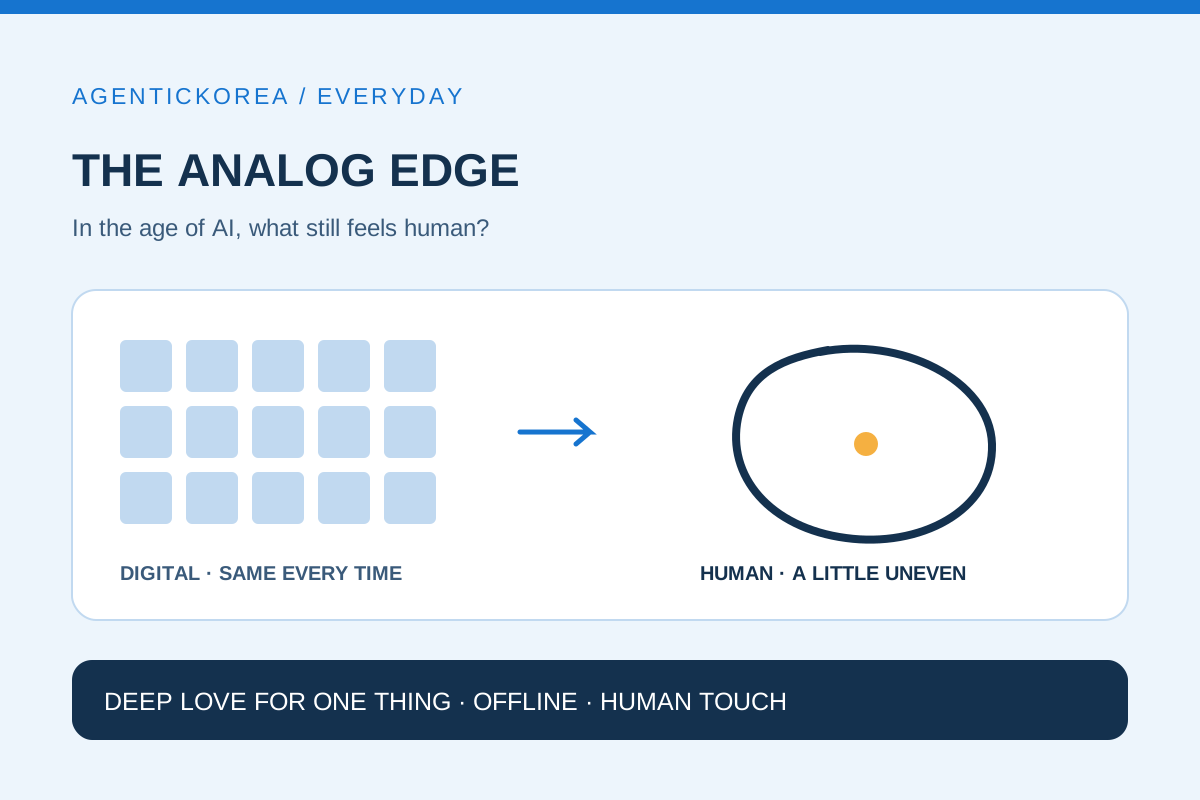
Writing and images made by AI are already smooth enough. The problem is that they are too smooth. When results of similar quality pour out endlessly, people start looking for a human touch within them instead: content where you can see who made it and why, and what that person went through to get there.
In my view, content with a human touch, anything that feels distinctly human, will become the real competitive edge. Whatever can be copied digitally without limit will keep getting cheaper, while what is hard to copy will become more valuable.
Would you keep watching a robot perform music?
Imagine a concert where a robot with incredible physical ability plays without missing a single note. I would probably watch it once or twice out of curiosity. But would I keep going back to see it? I am not so sure.
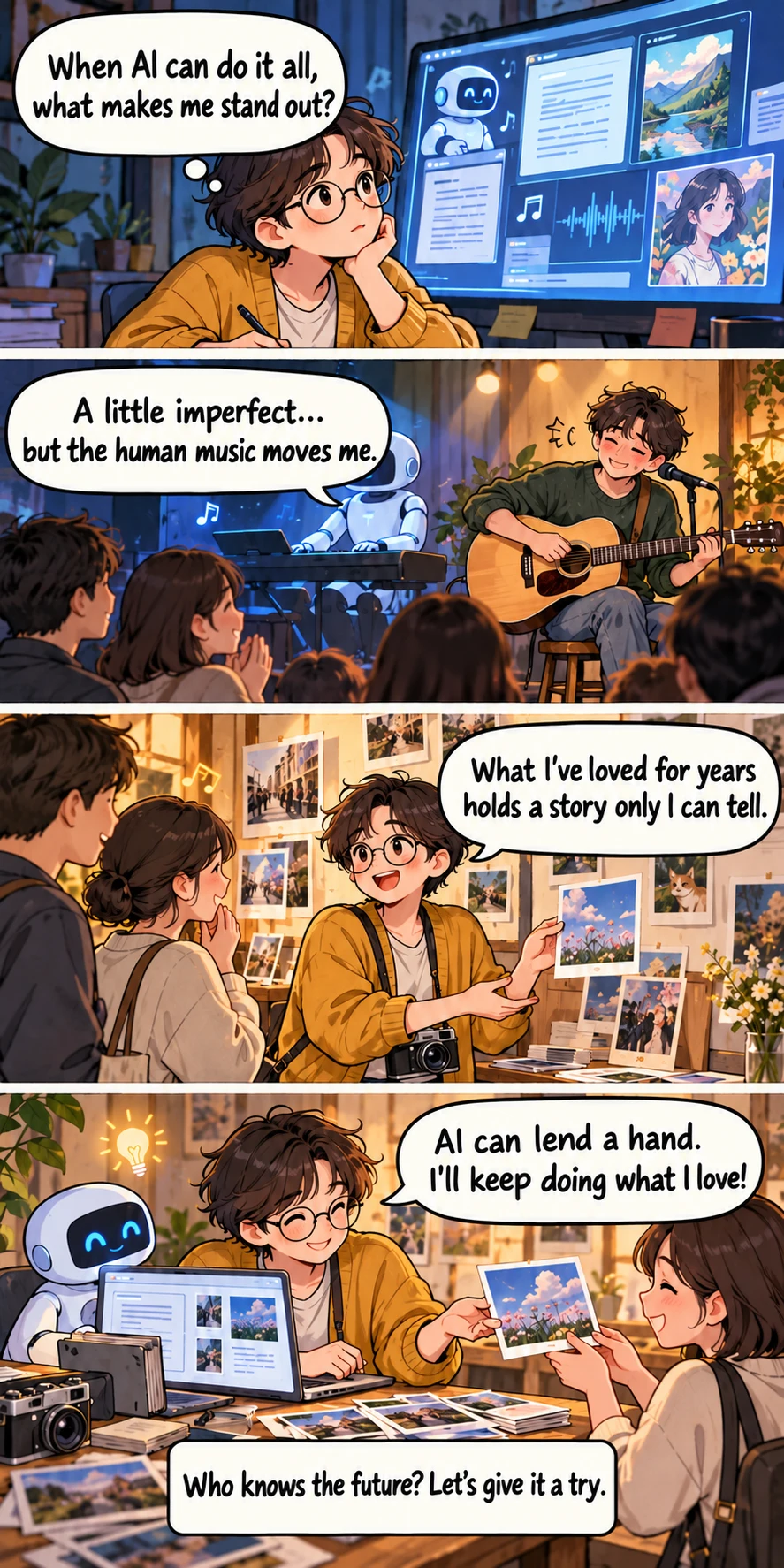
A human performance has instability. The tempo wavers a little with the player's condition that day, you hear a nervous breath, and sometimes there are mistakes. Yet that very instability is strangely attractive. Because it is not perfect, you feel the moment will never happen again, and your heart goes out to the person on stage.
On the other hand, I think things where the line between human and AI is blurry, things where nobody really wonders who made them, are likely to be fully replaced by digital tools. Think of standard notices or near-identical summaries. AI will do that kind of work faster and more cheaply.
So what edge prepares us for the age of AI?
Here my mind goes, a little unexpectedly, to Japan's otaku. Otaku (お宅) originally meant "your house" in Japanese and was also used as a polite way to address someone. In the 1980s it became slang for people deeply absorbed in a particular field such as anime, manga or games. It is said to have spread after columnist Akio Nakamori used the word in a 1983 magazine series (source: the Wikipedia article on otaku).
At first it carried a strong negative nuance of someone socially awkward, and that view has not fully disappeared. Since the 2000s, however, there has been more recognition of people who dig deep into one field and of their culture. In Korean, such people are often called deokhu, and their passion is called deokjil.
I am not sure the analogy is perfect. What I am focusing on is not the image of otaku but the attitude they have.
• A love that keeps digging into one thing, again and again
• The focus to stay with something for years without anyone asking
• The offline experience of collecting, visiting and meeting what you love in person
Where passion meets the offline world
AI is better than people at gathering and organizing information. But it is hard for AI to take on the affection of someone who has loved a subject for more than ten years, along with the context and stories only that person knows. That affection can only be passed on through people.
That is why I think intense focus on and interest in a specific subject, and the point where it connects to the offline and analog world, will become a competitive edge. Here are a few examples of what that might look like (these are examples I imagined).
• Someone who loves old film cameras holding a small exhibition of photos they shot and developed themselves
• Visiting a region's old shops again and again and recording the stories of the people who run them
• Someone who knows one music genre deeply hosting small listening sessions where people listen and talk together
AI can be an assistant here. Searching for material, polishing writing and drafting promotional copy can all be left to AI. But what you love, why you love it, and how and with whom you share it remain up to people.
Of course, nobody knows the future
Who knows how the times will change? I am not a futurist, and I am still at the stage of figuring out how to use AI well. Recently I also wrote about the distance between AI and reality in AI is racing ahead. Why do our workplaces look the same?.
Still, if I keep trying this and that, an answer will come, won't it? I plan to keep learning AI seriously while never letting go of the one thing I truly love. That one thing may be the most human edge in the age of AI. If you want to learn AI step by step, start with the learning guide.
Sources
위키백과 — 오타쿠 (어원 · 1983년 나카모리 아키오 · 인식 변화) ↗
Wikipedia — Otaku (etymology, Akio Nakamori 1983, changing perception) ↗